
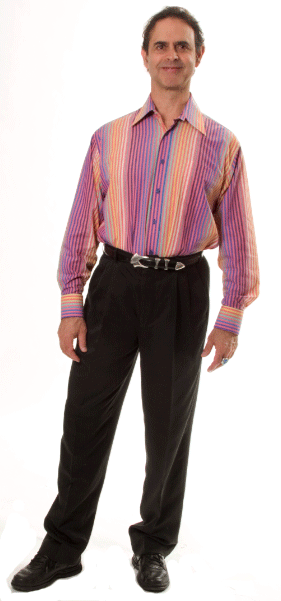
Metabolic Conditioning: An Actual Fitness Post

Introducing Dr. Lenny Kravitz.

Introducing Dr. Lenny Kravitz, Program Coordinator of Exercise Science, University of New Mexico, Albuquerque.

A few weeks ago, I heard Lenny Kravitz present his research at the the annual Can-Fit-Pro conference in Edmonton. I was quite excited by the chance to learn how the sultry retro singer maintains six-pack abs despite being in his late 40s. Imagine my surprise, then, when a white man wearing a bolo tie entered the room to grab the microphone. This Bizarro Lenny was actually quite a hoot, joking and laughing while discussing his recent findings on nutrient timing, the relationship between stress, cortisol and obesity, and metabolic conditioning. The last topic particularly caught my attention and, with Dr. Kravitz’s permission, I present some of his key points here. [Aside: my LSP has a great story about literally bumping into the “real” Lenny Kravitz in a Marais bagel shop in 1994, when we were living in Paris. At the time I was unfortunately in the library, reading about seventeenth-century French vaginas]. Continue reading

Perfectly Embodied: Guest Post by WhiteFeather Hunter

This work by WhiteFeather (made of animal bones, a beak, feathers, and human hair) hangs above my desk, protecting me from evil.

This work by WhiteFeather (made of animal bones, a beak, feathers, and human hair) hangs above my desk, protecting me from evil.

Introduction by FFG: I met WhiteFeather in Fredericton many years ago, admiring both her innovative art work and fearless personality. We had a lot in common, including a fierce commitment to feminist politics, borne out as we volunteered together to walk women and their families into the Morgentaler Clinic. Most importantly, we were and remain similarly enthralled by all things corporeal, things that others often find disgusting. WhiteFeather is now pursuing an MFA degree and she recently wrote me to describe a crit—when students present work for an audience of teachers and peers—during which she was condemned for using her naked, decorated body in a performance piece. Some viewers argued that her body was too attractive and could only be sexualized when placed on display.  Continue reading

Anatomy Lessons: Fighting Body Shame (aka It’s a Celebration, Bitches!)

indexIn a memoir called Fat Girl: A True Story (2005), author Judith Moore concludes “I am ashamed and I am resigned to my shame.” It is hard to blame Moore for failing to take pride in her fat body. Large bodies have been associated with inferior, primitive qualities, and considered to be unproductive, undisciplined, and weak for a very long time. Amy Farrell dates the rise of fat phobia to the end of the nineteenth century, when an emphasis on industrial efficiency made fat bodies seem wasteful, undermining their previous status as alluring signifiers of wealth (Fat Shame: Stigma and the Fat Body in American Culture, 2011). Continue reading

Gorilla Hands: A Female Powerlifter Confronts Body Ideals (Guest Post by babyeaterlifts)

My nickname through part of my undergraduate degree was “Gorilla Hands,” and the story behind this moniker is as follows: the boyfriend of a girl who lived on my floor during my short duration in the dormitories told his girlfriend that he thought I was “really cool, but that I have huge hands.” This girl—whose name I can no longer remember and am feeling vaguely guilty for it—relayed her boyfriend’s observation to me as I sat with her and a few other dwellers of the fourth floor of our dorm. I joked that I had “hands like a gorilla” and “Gorilla Hands” stuck. Continue reading

Body Shame

si-mammomat“I am now going to gather up the breast tissue from under your arm and push it onto the tray,” says Ana as she transforms my body into a scientific specimen. I am literally squeezed into place by the mammography machine, which feels smooth and cool as I lean in to embrace it. I look down in amazement at my right breast, now pancaked between two glass slides. At the same time, I am intellectually riveted, thinking about my relationship to technology and the Canadian health care system, especially my recent promotion to the age-related category considered “at risk” for breast cancer.  Continue reading